


Solving problems step by step
The following procedure is recommended
Write down on a piece of paper
- what the problem is and
- what goal is to be achieved,
- write down at least 3-4 ideas for a solution. These can also be surprising or unusual ideas. What would a manager or grandmother suggest?
- Check each individual solution idea for its advantages and disadvantages,
- decide on the best solution,
- divide the solution into individual steps and implement them in everyday life,
- check which steps were successful and whether the goal was achieved.
If the first attempt does not produce a satisfactory solution to the problem, consider which of the previous problem-solving steps should be revisited.
Solving problems step by step offers a general approach to overcoming difficulties without outside help.
Example 1 - Eating together with colleagues in the canteen
Mr. A. had made a habit of eating alone in his office. Now he thought about how pleasant it could be to eat together with his colleagues and have interesting conversations. But how should he make contact? As he couldn’t think of a solution straight away, he decided to tackle the problem step by step.
Practical application
He took a sheet of paper and wrote down,
- what is the problem and what is the goal to be achieved?
Problem: I eat alone too often and I get bored. My colleagues have been going out to eat together for a long time. Goal: To join a group.
- Write down at least 3-4 ideas for solutions. These can also be surprising or unusual ideas. What would a manager or grandmother suggest?
First write down everything that comes to mind:
- He could simply approach the colleague in the neighboring office to see if he can join him and his group.
- He could put a note on his office door saying: I’m hungry, take me with you!
- He could simply join his colleagues at the table.
- His grandmother had always been in favor of simply trying something new. He could see who else is sitting alone in the canteen and ask if he can join them.
- Check the pros and cons of each individual solution.
Re 1. Colleague – advantage: He had already spoken to the colleague in the office next door a few times. He seemed nice and regularly went to the canteen. Disadvantage: Mr. A. didn’t like two guys who accompanied his colleague.
Re 2. Note – advantage: Many people walk past the office and can read his call for help. Disadvantage: He would have to go with everyone who takes his call for help seriously.
Re 3. Sit down – advantage: He would sit at the same table as his colleagues. Disadvantage: Sometimes colleagues know each other personally and Mr. A. might be disturbing when discussing private matters.
Re 4. Grandmother – advantage: There are always colleagues who sit alone at the table because they have no one to talk to. Disadvantage: No one he could think of spontaneously. He could simply ask if he could sit down.
- Decide on the best solution.
Solution no. 4 seemed the easiest for Mr. A. to implement. After all, he could choose who he wanted to sit with.
- Divide the solution into individual steps and implement them in everyday life.
Step 1: Mr. A. would go to the canteen the very next day. Step 2: Once in the canteen, he would first get an overview of who was sitting alone at the table. Step 3: He would choose one person and greet them in a friendly manner: “Hello, is the seat next to you still free?” With the help of the talk2b® Beyond judgment method, Mr. A. would also find it easy to start a conversation.
- Check which steps were successful and whether the goal was achieved.
It worked straight away and even resulted in an interesting conversation.
Example 2 - Once again stress with parking offenders
Ms. B. came back from shopping in the evening in a good mood and wanted to park her car in the rented parking space. As she turned into her street, she noticed an unusual number of parked vehicles. A garden party was in full swing at her neighbor’s house. Her good mood turned to anger when she found a strange vehicle in her parking space. The anger prevented her from thinking clearly. So she began to solve the problem step by step.
Practical application
Although she didn’t have a sheet of paper to hand in the car, she remembered the individual steps for solving a problem, i.e.
- What is the problem and what goal should be achieved?
Problem: My parking space is occupied. Goal: Remove the other person’s vehicle.
- Write down at least 3-4 solution ideas. These can also be surprising or unusual ideas. What would a manager or grandmother suggest?
Mrs. B.’s mood was in full swing. She didn’t have to think long about the surprising and unusual.
- The classic. Park the car and wait to see what happens.
- Writing on the windshield with lipstick: No parking!
- Mingle with the guests and make an announcement like in a supermarket: “The owner of the vehicle with the license plate XYZ would like to come to his vehicle please”.
- An experienced manager would probably approach the problem less emotionally. He would ring the neighbor’s doorbell and point out the problem.
- Check each individual solution idea for its advantages and disadvantages.
Re 1. Parking up – Advantage: She would have peace for the time being and the solution would suit her anger. Let the other person get annoyed too. Disadvantage: You could wake them up in the morning to drive your own vehicle away.
Re 2. Lipstick – Advantage: The driver would have his misconduct directly in front of him in writing. It would be time-consuming to remove the lipstick and would allow time to think. Disadvantage: Perhaps the vehicle belongs to a woman who also has lipstick.
Re 3. Announcement – Advantage: She would have the guests’ full attention. Disadvantage: Might seem a bit over the top.
Re 4. Manager – Advantage: Keep calm. Using the talk2b® Beyond judgment technique to address only what is observable and nameable protects Ms. B. from appearing too emotional. She was also in the right. With PIRKA® Making a demand, she was able to emphasize her justified demand. Disadvantage: She would probably still be upset. Just take a deep breath and breathe out calmly. Then ring the bell.
- Decide on the best solution.
Solution no. 4 seemed realistic and promising.
- Divide the solution into individual steps and implement them in everyday life.
She skipped this point and marched purposefully to the neighbor’s door. The neighbor was understanding and the problem was solved.
- Check which steps were successful and whether the goal was achieved.
Looking back, she was glad that she had taken the time to solve the problem step by step. This allowed her to calm down a little and think about different solutions.
© 2025 PIRKA® Wolfgang Smidt. The content provided on this website is protected by copyright. Any use requires the prior written consent of the author. The information and advice provided has been compiled to the best of our knowledge and carefully checked. However, it is no substitute for expert psychological and medical advice in individual cases.
You can also use
Give it a try!
PIRKA wishes you every success in implementing it.
Literature
Bittner, A. & Helbig-Lang, S. (2020). Stressbewältigungs- und Problemlösetrainings. In Hoyer, J. & Knappe, S. (Hrsg.). Klinische Psychologie und Psychotherapie. Berlin: Springer.
Grawe, K., Donati, R. & Bernauer, F. (2001). Psychotherapie im Wandel. Göttingen: Hogrefe.
Kaiser, A. & Hahlweg, K. (2000). Kommunikations- und Problemlösetraining. In Margraf, J. (Hrsg.). Lehrbuch der Verhaltenstherapie. Band 1. Heidelberg: Springer.
Kruse, J. (2020). Problemlösen. In Wirtz, M. A. (Hrsg.). Dorsch. Lexikon der Psychologie. Göttingen: Hogrefe.
Liebeck, H. (2011). Problemlösetraining. In Linden, M. & Hautzinger, M. (Hrsg.). Verhaltenstherapiemanual. Heidelberg: Springer.

Think in terms of progress instead of striving for perfection
The following procedure is recommended
When completing tasks, remember that
- tasks are rarely completed in one step, but in stages.
- goals are not always achieved immediately, but in stages.
Say quietly to yourself in your thoughts:
- The problem can be solved.
- Step by step.
- What do I have to do next?
And then:
- Pay attention to progress.
- Recognize progress as your own achievement.
- Praise yourself: Well done!
Observing and naming concrete progress helps to overcome blocking ideas of the perfect result and to finally start the task.
Example 1 - Sweeping stairs
The staircase had 30 steps and he was determined to finish it today. In his mind, the result of the spotlessly clean staircase kept popping up. But when he looked at the stairs, there was a lot of dirt and moss. How was he going to manage that today? He felt a pressure, was blocked and stared at the stairs.
Practical application
When completing tasks, remember that
- tasks are rarely completed in one step, but in stages.
- goals are not always achieved immediately, but in stages.
Say silently to yourself:
- The problem can be solved.
- Step by step.
- What do I have to do next?
He said to himself inwardly: The problem can be solved. Step by step and started with the first step. He pushed aside the thought of the result of the completely swept staircase. The first step was finished: what do I have to do next? Then he started on the second, much dirtier step and so on.
- Pay attention to concrete progress.
Twelve steps had already been completed.
- Recognize progress as your own achievement.
- Praise yourself: Well done!
The individual steps were dirtier than initially assumed. It started to rain. After all, he had completed 12 of the 30 steps and made progress. He praised himself for it: Well done. We’ll continue tomorrow.
Example 2 - Writing a project thesis
It should be a good to very good grade. She looked at her previous notes and the few loose sheets. She felt an inner pressure and the fear of failing. Should she start with the introduction straight away or should she compile the list of references first? She also had to organize the table of contents! Wasn’t there another article that needed to be read? She also had to go shopping and the bathroom needed cleaning.
Practical application
When completing tasks, remember that
- tasks are rarely completed in one step, but in stages.
- goals are not always achieved immediately, but in sub-goals.
She remembered that the project work could only be completed in individual steps anyway and that the goal, the good grade, could only be the result of these individual steps. She would only see whether it would be a perfect result at the end.
She said silently to herself:
- The problem can be solved.
- Step by step.
- What do I have to do next?
In her thoughts she said to herself: The problem can be solved. Step by step. What do I have to do next? She decided to start with the literature list first. Compiling the literature she had read so far would be quite easy and she would be able to see her initial progress straight away. She took 50 minutes to do this and noticed how an increasingly long list of literature appeared before her eyes.
- Pay attention to concrete progress.
One DIN A4 page of literature was done. Great!
- Recognize progress as your own achievement.
- Praise yourself: Well done!
That was important progress: well done, she thought. She felt good. Next she would go shopping and start the first chapter in the afternoon. She could then add the chapter title to the table of contents.
© 2025 PIRKA® Wolfgang Smidt. The content provided on this website is protected by copyright. Any use requires the prior written consent of the author. The information and advice provided has been compiled to the best of our knowledge and carefully checked. However, it is no substitute for expert psychological and medical advice in individual cases.
You can also use
Give it a try!
PIRKA wishes you every success in implementing it.
Literature
Delb, W., D’Amelio, R., Archonti, C. & Schonecke (2002). Tinnitus. Ein Manual zur Tinnitus-Retrainingtherapie. Göttingen: Hogrefe.
Leahy, R.L. (2007). Techniken kognitiver Therapie. Junfermann Verlag: Paderborn.
Meichenbaum, D. (2003). Interventionen bei Stress. Hans Huber: Göttingen.
Wirtz, A.M. (Hrsg.) (2020). Dorsch – Lexikon der Psychologie. Bern: Hogrefe.

Calculate self-criticism
The following procedure is recommended
- think about the event for which you feel criticized, responsible or guilty,
- use a number from 0 to 100 % to estimate the percentage of responsibility you feel for the event,
- list other reasons and factors that also (!) have or had an influence on the event,
- estimate the percentage of influence each individual reason or factor has or had on the event. Please note: Do not give more than 100 % percent in total,
- add up the percentages of the factors and subtract them from 100%,
- the remaining percentage points correspond to the personal influence on the negative event.
Please note
Only those who have a direct influence on a negative event or happening can take responsibility for the event.
Realistically assessing your personal influence on a negative event or occurrence protects you from premature self-criticism and unnecessary feelings of guilt.
Example 1 - Project not komplette on time
Only those who have a direct influence on a negative event or happening can take responsibility for it. An important project could not be completed by the set deadline. As the project manager, he felt bad because he saw the main responsibility as lying with himself. He criticized himself for his “poor performance”. But was it really just down to him or were there other factors that he hadn’t taken into account enough and that also had an influence on the slow progress of the project?
Practical application
Please note: Written notes are more helpful for this exercise than mental arithmetic. He took a sheet of A4 paper and a pencil. He wrote down what he was criticizing himself for.
- That the project had not been completed on time.
- He felt that he was 70% responsible for this.
He then considered other reasons and factors that had an influence:
- High sickness rate: out of 10 employees, only 6 were available at times.
- Supply bottlenecks: An important supplier had failed and could only be replaced with difficulty.
- Software problems: An update was faulty. Work on the project had to be suspended for 3 days.
- Planning errors: Necessary corrections to the planning were more costly than could have been foreseen.
He considered what percentage influence each individual factor had on the result. Maximum 100% percent awarded!
High sickness rate 30 %
Delivery bottlenecks 10 %
Software problems 25 %
Planning errors 15 %
- Add up the percentages and subtract from 100 %.
30 + 10 + 25 + 15 resulted in 80 % external influence on the negative event.
- The remaining percentage points corresponded to his personal influence on the event. 100 – 80 = 20 % personal influence.
The percentage value of 20% corresponded to a more realistic personal influence on the course of the project than the previously perceived 70% percent. The bad feeling and self-criticism decreased noticeably.
Example 2 - Forgotten birthday
Only someone who has a direct influence on a negative event or happening can take responsibility for it. She remembered that her friend had already had a milestone birthday 10 weeks ago. It had been her 50th birthday of all things. What would her friend think of her? A feeling of guilt spread through her. However, she didn’t want to simply accept the feeling and decided to think about whether there were other reasons or factors that had led to this omission.
Practical application
Please note: Written notes are more helpful for this exercise than mental arithmetic. She got a sheet of A4 paper and a pencil. She wrote down what she was criticizing herself for.
- That she had forgotten her 50th birthday.
- The feeling of guilt was palpable, so she gave herself 100% percent!
Then she thought about other reasons and factors that had an influence:
- Moving house – She had moved to her new apartment on her friend’s birthday and had been very tired that evening.
- Job – The move had become necessary because she had accepted a new job. The first few weeks had been characterized by long working days and new impressions.
- New relationship – Shortly before the move, she had met a new man with whom she had spent a lot of time.
She thought about what percentage influence each individual factor had had on her forgetting her birthday. Maximum 100% percent forgiven!
Relocation 20 %
Working hours 20 %
New relationship 50 %
- Add the percentages together and subtract from 100%.
20 + 20 + 50 resulted in 90 % external influence on the forgotten phone call.
- The remaining percentage points corresponded to their personal influence on the event. 100 – 90 = 10 % personal influence.
The percentage value of 10 % corresponded to a more realistic assessment than the previously perceived 100 %. So many new things had happened in her life that she had simply forgotten about the birthday. The bad feeling and self-criticism diminished noticeably. She resolved to call her friend.
© 2025 PIRKA® Wolfgang Smidt. The content provided on this website is protected by copyright. Any use requires the prior written consent of the author. The information and advice provided has been compiled to the best of our knowledge and carefully checked. However, it is no substitute for expert psychological and medical advice in individual cases.
Give it a try!
PIRKA wishes you every success in implementing it.
Literature
Emmelkamp, P.M.G. & van Oppen, P. (2000). Zwangsstörungen. Fortschritte der Psychotherapie. Göttingen. Hogrefe
Lakatos, A. & Reinecker, H. (2001). Kognitive Verhaltenstherapie bei Zwangsstörungen. Göttingen: Hogrefe
Leahy, R. L. (2007). Techniken kognitiver Therapie. Paderborn: Junfermann Verlag

relaxONnaming® surrounding to fall asleep
The following procedure is recommended
- lie down and switch off the light,
- get used to the darkness of your surroundings with your eyes open,
- observe your surroundings and
- name a thing or object that you see,
- only ever use one (!) word when naming,
- say the word silently to yourself,
- take a short pause after each word,
- in which your gaze continues to wander quietly and
- name another thing or object in the room.
- Continue the exercise until your mind has calmed down.
It takes a little time for the thoughts you were previously preoccupied with to calm down and for the restlessness to subside.
Important note
Observing and naming surrounding is merely a matter of spatial orientation. Restlessness needs time to settle. A little patience is therefore necessary and helpful. If the restlessness persists, the exercise can be ended at any time by concentrating on another task or activity.
Do not use relax on naming when driving a vehicle or operating machinery, as it can cause you to fall asleep when you are already tired.
Relax on naming the surrounding can help to shorten waking phases and brooding and to find inner peace to fall asleep.
Example 1 - Fall asleep calmly
It was always the same. As soon as he lay down, the worries started. But no matter how often he thought about it, he couldn’t find a solution. So he lay down comfortably in bed and switched off the light. Once his open eyes had adjusted to the darkness, he recognized the various things in the room. His gaze first wandered to the cupboard in the corner. He said the word “cupboard” in his mind. He always chose the word that immediately came to his mind. Calmly and without haste, his gaze moved on to the window. He said the word “window” in his mind. Then his gaze wandered to the ceiling. He said the word “ceiling” in his mind. His gaze wandered to the other corner of the room. It was darker than the previous one. In his mind, he said the word: “dark”. His gaze wandered to the curtains. In his mind, he said the word: “Curtain”. The evening light fell through the curtains. In his mind he said the word: “Light”. His gaze wandered further and he heard a car. He said the word “car” in his mind. He listened into the room and heard nothing. In his mind he said the word: “Silence”. His gaze continued to wander until he felt an inner calm. He closed his eyes and surrendered to the inner peace.
Practical application
He observed the surroundings of the room and named in his mind with just one word what his gaze fell on: cupboard … short pause, in which his gaze continues to wander quietly … window … short pause, in which his gaze continues to wander quietly … ceiling … short pause, in which his gaze continues to wander quietly … dark … short pause, in which his gaze continues to wander quietly … curtain … short pause … light … short pause … car … short pause … silence …
Example 2 - Disturbances when falling asleep
She lay down in bed with her husband, but unlike him, she couldn’t fall asleep straight away. At first she heard his soft snoring. She said the word “sound” in her mind. Then she looked at her surroundings. Her eyes fell on the lamp on the ceiling. She said the word “lamp” in her mind. The snoring could be heard again. She said the word “sound” again in her mind. Her eyes fell on the wardrobe. In her mind, she said the word: “Cupboard”. Her husband turned over in bed. The mattress moved. She said the word: “Movement”. Then her eyes fell on the window. In her mind she said the word: “Window.” A dog barked in front of the house. She said the word in her mind: “Dog.” Then a cat hissed. In her mind she said the word: “Cat.” In the room, her eyes fell on the dark wall. In her mind she said the word: “Wall”. Then everything was quiet. In her mind she said the word: “Stillness”. She continued the exercise until she felt an inner calm. Then she finished the exercise and surrendered to the inner peace.
Practical application
Observing the surroundings of the bedroom, she named what her gaze fell on or what sounds she heard and said the respective word in her mind: sound … short pause, in which her gaze continues to wander quietly … lamp … short pause … sound … short pause, in which her gaze continues to wander quietly … cupboard … short pause … movement … short pause, in which her gaze continues to wander quietly … window … short pause … dog … short pause … cat … short pause … stillness …
© 2025 PIRKA® Wolfgang Smidt. The content provided on this website is protected by copyright. Any use requires the prior written consent of the author. The information and advice provided has been compiled to the best of our knowledge and carefully checked. However, it is no substitute for expert psychological and medical advice in individual cases.
Give it a try!
PIRKA wishes you every success in implementing it.
Literature
Baltissen, R. & Sartory, G. (1998). Orientierungs-, Defensiv- und Schreckreaktionen: Grundlagenforschung und Anwendung. In Rösler, F. (Hrsg.). Ergebnisse und Anwendungen der Psychophysiologie. Enzyklopädie der Psychologie. Biologische Psychologie. (S. 1-35)
Bateson, G. (1981). Ökologie des Geistes. Frankfurt. Suhrkamp.
Bösel, R. (2009). Neuropsychologie. In Brandstätter, V. & Otto, J. H. (Hrsg.). Handbuch der Allgemeinen Psychologie. Motivation und Emotion. Göttingen: Hogrefe.
Dörner, D. (1998). Emotionen, kognitive Prozesse und der Gebrauch von Wissen. In Klix, F. & Spada, H. (Hrsg.), Enzyklopädie der Psychologie. Wissen. Kognition. (S. 301-330). Göttingen: Hogrefe.
Eimer, M., Nattkemper, D., Schröger, E & Prinz, W. (1996). Unwillkürliche Aufmerksamkeit. In O. Neumann & A. F. Sanders (Hrsg.), Enzyklopädie der Psychologie. Aufmerksamkeit. Kognition 2 (S. 219-258). Göttingen: Hogrefe.
Gamer, M. (2019). Aufmerksamkeit. In Pinel, J. P. J., Barnes, S. J. & Pauli, P. (Hrsg.). Biopsychologie. München: Pearson.
Grawe, K. (2004). Neuropsychotherapie. Göttingen: Hogrefe.
Herrmann, T. (2003). Planung und Regulation der Sprachproduktion. In Herrmann T. & Grabowski, J. (Hrsg.), Enzyklopädie der Psychologie. Sprachproduktion. Sprache 1 (S. 309-327). Göttingen: Hogrefe.
Hoffmann, J. (1994). Die visuelle Identifikation von Objekten. In Prinz, W. & Bridgeman, B. (Hrsg.), Enzyklopädie der Psychologie. Wahrnehmung. (S. 391-444). Göttingen: Hogrefe.
Kintsch, W. (1982). Gedächtnis und Kognition. Heidelberg: Springer.
Klein, R. M. & Ivanoff, J. (2005). Inhibition of Return. In Itti, L., Rees, G. & Tsotsos, J. K. (Eds.). Neurobiology of Attention. Amsterdam: Elsevier Academic Press.
Klix, F. (1976). Information und Verhalten. Kybernetische Aspekte der organismischen Informationsverarbeitung. Bern: Huber.
Klix, F. (1976). Über Grundstrukturen und Funktionsprinzipien kognitiver Prozesse. In F. Klix (Hrsg.). Psychologische Beiträge zur Analyse kognitiver Prozesse. Kindler: München.
Klix, F. (1998). Begriffliches Wissen – episodisches Wissen. In Klix, F. & Spada, H. (Hrsg.), Enzyklopädie der Psychologie. Wissen. Kognition. (S. 167-205). Göttingen: Hogrefe.
Koelega, H.S. (1996). Vigilanz. In O. Neumann & A. F. Sanders (Hrsg.), Enzyklopädie der Psychologie. Aufmerksamkeit. Kognition 2 (S. 403-467). Göttingen: Hogrefe.
Lau, F. (2012). Die Form der Paradoxie. Eine Einführung in die Mathematik und Philosophie der Laws of Form von George Spencer Brown. Heidelberg: Carl-Auer.
Luhmann, N. (1998). Die Wissenschaft der Gesellschaft. Frankfurt: Suhrkamp.
Luhmann, N. (2004). Einführung in die Systemtheorie. Heidelberg: Carl Auer.
Manzey, D. (1998). Psychophysiologie mentaler Beanspruchung. In F. Rösler (Hrsg.), Enzyklopädie der Psychologie. Ergebnisse und Anwendungen der Psychophysiologie. Biologische Psychologie. (S. 799-850). Göttingen: Hogrefe.
Moosbrugger, H. & Oehlschlägel, J. (2019). FAIR-2. Frankfurter Aufmerksamkeits-Inventar 2. (2., überarb. u. erg. Auflage des FAIR 1996). Göttingen: Hogrefe.
Müller, H. & Krummenacher, J. (2012). Funktionen und Modelle der selektiven Aufmerksamkeit. In Karnath, H-O. & Thier, P. (Hrsg.). Kognitive Neurowissenschaften. Berlin: Springer.
Norman, D. & Bobrow, G. (1975). On Data-limited and Ressource-limited Processes. Cognitive Psychology, 7, 44-64
Olst, E. H. ((1971). The Orienting Reflex. Mouton. De Gruyter.
Pechmann, T. (2003). Experimentelle Methoden. In Herrmann T. & Grabowski, J. (Hrsg.), Enzyklopädie der Psychologie. Sprachproduktion. Sprache 1 (S. 27-45). Göttingen: Hogrefe.
Schönwälder, T., Wille, K. & Hölscher, T. (2004). George Spencer-Brown. Eine Einführung in die „Laws of Form“. Wiesbaden: VS Verlag.
Schweizer, K. (2003). Das sprachliche Lokalisieren. In Herrmann T. & Grabowski, J. (Hrsg.), Enzyklopädie der Psychologie. Sprachproduktion. Sprache 1 (S. 623-652). Göttingen: Hogrefe.
Semmer, N. K., Grebner, S. & Elfering, A. (2010). Psychische Kosten von Arbeit: Beanspruchung und Erholung, Leistung und Gesundheit. In U. Kleinbeck & K. H. Schmidt (Hrsg.), Enzyklopädie der Psychologie. Arbeitspsychologie. (S. 325-358). Göttingen: Hogrefe.
Sokolov, E. N., Spinks, J. A., Näätänen, R. & Lyytinen, H. (2002). The Orienting Response in Information Processing. London: Lawrence Erlbaum Associates.
Sokolov, E. N. (2013). The Psychophysiology of Conciousness. New York: Oxford University Press.
Spencer-Brown, G. (1979). Laws of Form. New York: Dutton.
Sturm, W. (2008). Aufmerksamkeitsstörungen. In Gauggel, S. & Herrmann, M. (Hrsg.). Handbuch der Neuro- und Biopsychologie. Göttingen: Hogrefe.
Tucker, D. M. & Williamson, P. A. (1984). Asymmetric Neural Control Systems in Huma Self-Regulation. Psychological Review. Vol. 91, No. 2, 185-215
van der Meer, E. & Klix, F. (2003). Die begriffliche Basis der Sprachproduktion. In Herrmann T. & Grabowski, J. (Hrsg.), Enzyklopädie der Psychologie. Sprachproduktion. Sprache 1 (S. 333-355). Göttingen: Hogrefe.
van der Molen, M.W. (1996). Energetik und der Reaktionsprozess. Zwei Leitlinien der Experimentalpsychologie. In O. Neumann & A. F. Sanders (Hrsg.), Enzyklopädie der Psychologie. Aufmerksamkeit. Kognition 2 (S. 333-395). Göttingen: Hogrefe.
Weiß, P. & Barattelli, S. (2003). Das Benennen von Objekten. In Herrmann T. & Grabowski, J. (Hrsg.), Enzyklopädie der Psychologie. Sprachproduktion. Sprache 1 (S. 587-615). Göttingen: Hogrefe.

Reduce self-criticism through comparisons
The following procedure is recommended
- Think about which characteristic you think you have less of compared to another person,
- on a scale of 1 to 10, how stressful does this feel to you? (1 hardly stressful to 10 very stressful),
- now think of a person who, compared to you, has much less or none of the qualities you have,
- think about how much more than “nothing at all” you already have of the characteristic,
- think about how stressful it feels for them after the comparison from 1 to 10.
Comparing ourselves with other people who have less than we do can boost our satisfaction.
Example 1 - Comparison with the best in class at school
She criticized herself for the fact that there were two students who had an even better average grade than her. Both students had achieved a grade of A in their final report, she had achieved a grade of A-. She felt like a failure and had been angry with herself for days.
Practical application
She constantly thought about being less clever than other pupils. That was very stressful for her. On a scale of 1 to 10, she would definitely choose 10. The 10 accurately reflected all her disappointment and sadness. Now she thought of her best friend Petra, who had achieved an average grade of C, even though she had studied a lot. Peter even had a grade point average of
D. And three of her classmates hadn’t even managed to graduate due to poor grades. I wonder how they would fare? Of course, hard work and luck also play a role in grades. When she thought again about how much more she had achieved than other classmates, it didn’t feel so burdensome. On second thought, the 10 was far too high. After the comparison, she would choose a 2, because she was clever and had achieved much more than many of her classmates with a grade of A-.
We must be careful not to compare ourselves only with the best. Comparing ourselves with other people who have less than we do can boost our satisfaction.
Example 2 - Orienting yourself towards richer people
As an entrepreneur, he had already saved a considerable sum, but there were even richer people than him in his circle of acquaintances and even millionaires with whom he compared himself. This was very frustrating for him. He kept imagining how he would feel as a millionaire.
Practical application
He definitely thought he had too little money compared to other people. That put a lot of pressure on him. On a scale of 1-10, he would rate the burden he felt as a 9. Then he thought of a friend who earned very little money as an employee and had to feed a family of four. And the beggar who sat in the same parking lot over and over again and left it up to people to decide whether and how much money they would give him. He had a lot more than the beggar: a nice house, money for vacations and two cars. He could buy new clothes, even if he didn’t need them, and visit restaurants. The beggar wore the same dirty pants and sweaters over and over again and could only afford a few simple meals. In that sense, he had a lot more money than many other people. The comparison made him think. The burden had given way to compassion. On a scale of 1-10, he gave himself a 1. He had everything he needed.
Other topics can also be edited using this method. Think of appearance, for example: The desire to compare yourself with models and despair about your own appearance. Or your career: a feeling of failure at not having climbed further up the career ladder. Or think of sport: the comparison with particularly talented people or masters in the field who have had the appropriate physical prerequisites from an early age.
© 2025 PIRKA® Wolfgang Smidt. The content provided on this website is protected by copyright. Any use requires the prior written consent of the author. The information and advice provided has been compiled to the best of our knowledge and carefully checked. However, it is no substitute for expert psychological and medical advice in individual cases.
Give it a try!
PIRKA wishes you every success in implementing it.
Literature
Filipp, S.H., Klauer, T. & Ferring, D. (1993). Self-Focused Attention in the Face of Adversity and Threat. In H.W. Krohne (Editor) (1993). Attention and Avoidance. Seattle: Hogrefe.
Leahy, R. L. (2007). Techniken kognitiver Therapie. Paderborn: Junfermann Verlag

Self-criticism from three different perspectives
The following procedure is recommended
- On a scale from 0 (low) to 10 (very severe), rate how much you criticize and condemn yourself for an event or behavior. Note the number,
- How severely would you criticize or condemn another person, e.g. a friend, to whom the same thing had happened? Write down the number,
- How severely would another person, e.g. a friend, criticize or condemn you for what happened? Write down the number,
- add the three numbers together and divide by 3. Doesn’t the new number represent a more realistic and fair judgment of themselves?
Looking at self-criticism from three different perspectives can help you to judge yourself less harshly for a behavior or event.
Example 1 - Stain on the pants
He only noticed the stain on his trousers shortly before the interview.
Practical application
He judged himself for his lack of attention with a 9 on a scale of 0 to 10. If this had happened to his best friend, he would probably have smiled at his self-criticism and comforted him: “It can happen to anyone”. He would have given his friend a 0 on the scale. His girlfriend would also know his excitement from other contexts and would say that it probably wasn’t that bad and that it was more about the conversation itself. She would also give him a 0 on the scale.
Mathematically, the three perspectives result in: 9+0+0=9 and 9:3=3
After switching perspectives, he immediately felt better. Conclusion: Sometimes we judge ourselves for a behavior much more harshly than we would judge other people for the same behavior. Does it have to be that way?
Example 2 - becoming unfriendly towards a customer
The weather was glorious and people were looking for seats in the cafés. As a service employee, she therefore had to be quick and could not respond to every customer as she was used to. She was very annoyed that she had become loud with a dissatisfied customer. Shortly afterwards, the same thing happened to a colleague of hers.
Practical application
She thought that this should not have happened to her because of her many years of professional experience. She felt very bad and gave herself full responsibility and a 10 on a scale of 0 to 10. Then she thought of her colleague who had also lost her temper and surprisingly quickly found an excuse for her behavior: “She’s actually a very calm colleague who is happy to see every guest. With that many customers, you quickly reach your limits.” She would only have given her colleague a 2 for the same behavior. She wondered what her boss would think of her. He would probably think that it was the first time in three months that she had lost her temper. He wouldn’t take it so dramatically either and would probably give her a 3.
In purely mathematical terms, this resulted in: 10+2+3=15 and 15:3=5
Conclusion: She felt that the 5 was still very high. Since it was an oversight and she had also apologized, she decided not to judge herself any further. Sometimes we judge ourselves for a behavior much more harshly than we would judge other people for the same behavior. Does it have to be that way?
© 2025 PIRKA® Wolfgang Smidt. The content provided on this website is protected by copyright. Any use requires the prior written consent of the author. The information and advice provided has been compiled to the best of our knowledge and carefully checked. However, it is no substitute for expert psychological and medical advice in individual cases.
Give it a try!
PIRKA wishes you every success in implementing it.
Literature
Emmelkamp, P.M.G. & van Oppen, P. (2000). Zwangsstörungen. Fortschritte der Psychotherapie. Göttingen. Hogrefe
Lakatos, A. & Reinecker, H. (2001). Kognitive Verhaltenstherapie bei Zwangsstörungen. Göttingen: Hogrefe
Leahy, R. L. (2007). Techniken kognitiver Therapie. Paderborn: Junfermann Verlag

Load ladder with 10 steps
The following procedure is recommended
- consider which event is stressful or difficult for you to bear,
- rate the severity of the stress with a number on the stress ladder from level 1 (bearable) to level 10 (unbearable),
- assign a different event to each of the remaining 9 levels of the stress ladder, which corresponds to the numerical value of the respective stress level.
- Start with the 10th level (unbearable) and descend to the 1st level (bearable).
Comparing personally stressful events with other critical life events can help you to gain more distance.
The following are examples of stressful life events that are associated with varying degrees of personal stress. This method is not suitable for dealing with threatening or traumatic life events such as the death of a loved one, war or life-threatening illness. This requires other forms of help. However, for all other everyday worries or problems, the extreme life events just mentioned can serve as examples and a benchmark for stress level 10 and thus be helpful in reassessing the personal situation.
Examples of stressful life events
Loss of a job, insults, separation from a partner, childlessness, financial losses, trouble with a superior, failing an exam, injustice, money worries, imprisonment, quarrel in the family, loss of contact with a loved one, accident, lack of promotion, children leaving home, personal achievements not being recognized, etc.
Example 1 - I can't stand it that he doesn't call
She had already gone out with him three times and they had become close. She could well imagine staying with him. He was so different from all the other men. He had promised to get back to her. She had been waiting for his call for three days now. The evening messages on her cell phone had also failed to appear. And then she saw him in town with another woman in his arms.
Practical application
She was extremely angry and hurt. She remembered the 10-step stress ladder.
- Think about which event is stressful or difficult for you to bear?
The man had not contacted her and was seeing another woman.
- Rate the severity of the stress with a number on the stress ladder from level 1 (bearable) to level 10 (unbearable).
It felt like a 9. She was very sad and disappointed. She felt constantly rejected.
- Assign a different event to each of the remaining 9 levels of the stress ladder, corresponding to the numerical value of the stress level. Start with the 10th step (unbearable) and descend to the 1st step (bearable).
She thought about how she should proceed. On the stress ladder, the death of her parents would certainly mean level 10. Level 9 was already occupied. She would put an accident or serious illness at level 8. Level 7 would be the loss of a job. On level 6, a prison sentence or a dispute within the family? And level 5? And if her best friend suddenly broke off contact, would that be a 5? It was starting to get weird. Was it worth a 9? Was the fact that the guy was seeing someone else and had betrayed her worse than an accident or a serious illness (8) or that her best friend would break off contact for good? No, certainly not! Compared to the other problems, the one with the guy was probably more of a 4 or 5. She said to herself quietly: “I can bear it, but it’s not easy. I’ll need a little time to get over it. She called her best friend to arrange a meal and tell her about it.
Example 2 - Although I did my best, the colleague was promoted
He was not one of the colleagues in the company who was late, lazy or frequently ill. He identified with the company’s values. After all these years, his superiors couldn’t have missed that. And then, when the position of head of department became vacant, he saw his chance. But a younger colleague with a university degree got the job.
Practical application
He thought: What else can I do? What else makes sense? He was pissed off, no, bitter, no, angry … or all of the above!
- Think about which event is stressful or difficult for you to bear?
Although his promotion was long overdue, someone else was preferred.
- Rate the level of stress with a number on the stress ladder from level 1 (bearable) to level 10 (unbearable).
It felt like level 8 on the stress ladder.
- Assign a different event to each of the remaining 9 levels of the stress ladder, corresponding to the numerical value of the stress level. Start with the 10th step (unbearable) and descend to the 1st step (bearable).
He thought about what would be comparable to level 10 on the stress ladder. As a man of business, he thought of the collapse of the global economy at level 10. Level 9 would then be the subsequent financial chaos. At level 7, he would no longer be able to service his financial burdens. Then he thought about personal matters. What if one of his children were unwell? Would that be a 6? And what if something happened to his wife? Only level 5 remained for this idea. And level 4? What if his parents became seriously ill? No, he would have to rethink the lack of promotion. Sure, it felt really bad and he was very disappointed in his superiors, but there were events as a result of his step-by-step evaluations that would be far more depressing than the lack of recognition at work.
© 2025 PIRKA® Wolfgang Smidt. The content provided on this website is protected by copyright. Any use requires the prior written consent of the author. The information and advice provided has been compiled to the best of our knowledge and carefully checked. However, it is no substitute for expert psychological and medical advice in individual cases.
Give it a try!
PIRKA wishes you every success in implementing it.
Literature
Bastine, R. (1984). Klinische Psychologie. Stuttgart: Kohlhammer.
Filipp, S.H., Klauer, T. & Ferring, D. (1993). Self-Focused Attention in the Face of Adversity and Threat. In H.W. Krohne (Editor) (1993). Attention and Avoidance. Seattle: Hogrefe.
Leahy, L.L. (2007). Techniken kognitiver Therapie. Paderborn: Junfermann.
Linden, M. (2017). Verbitterung und posttraumatische Verbitterungsstörung. Göttingen: Hogrefe.
Maercker, A. (2009). Posttraumatische Belastungsstörungen. Heidelberg: Springer.
Reinecker, H. (2020). Life-Event-Forschung. In Wirtz, A.M. (Hrsg.). Dorsch – Lexikon der Psychologie. Bern: Hogrefe.
Hunger and ability to concentrate
The following procedure is recommended
In everyday life and at work, the following symptoms may indicate existing hunger:
- Difficulty concentrating.
- Difficulty making decisions.
- Irritable, anxious or bad mood.
- Repeated thoughts about food.
- Conspicuous consumption of chewing gum, nicotine, coffee or tea.
- Sleep disturbances with early waking.
- Dizziness and headaches.
- Slight chills, ringing in the ears or flickering eyes.
- Excessive hunger in the evening.
Important note
Organic diseases with similar complaints must be ruled out by the doctor.
The symptoms are not the result of the effects of medication, alcohol or drugs.
Regular meals can help to alleviate the symptoms.
Concentration problems and physical complaints can be the result of ignoring hunger and can be alleviated by eating enough.
Example - Workday
He had long since gotten out of the habit of eating breakfast in the morning and starting work at 8 o’clock. At 10 a.m. he liked to have some fruit, sometimes even a loaf of bread. He rarely ate at lunchtime, as important meetings cut his lunch break short. Eating something quick, such as salads, had already become a habit. In the afternoon, he usually noticed a drop in performance. His colleagues found that he was often very irritable. His coffee consumption was noticeably high and he almost always had chewing gum in his mouth. Of course, he was always thinking about food, but time was the problem. In the evening, his wife was pleased that he enjoyed the food. But one plate was often not enough, he liked to have two. Late in the evening, he went to the fridge. Only now did he realize that he was dealing with food cravings. His fundamental problem was that he was consuming too little energy throughout the day, i.e. during the time when he needed energy due to mental and physical exertion, resulting in a noticeable loss of mental performance.
Practical application
He remembered the phrase “eat like an emperor in the morning, like a king at lunchtime and like a beggar in the evening”. But he hadn’t eaten breakfast for years. In response to his argument about not being able to eat in the morning, he asked himself the following question: he wondered how he would eat breakfast on vacation or in a hotel if there was enough time and the table was richly laid. He decided to have breakfast in the morning and eat enough at lunchtime to improve his personal performance throughout the day. Breakfast was a real struggle at first. Later, he took sandwiches with him that he had eaten in the morning. After a while, he noticed improved concentration during the day and a reduced feeling of hunger in the evening. He also felt hungry again at lunchtime. Irritability and the amount of coffee consumed decreased. He achieved another goal of drinking enough by drinking a 0.5 liter bottle on the way to work. Then another 0.5 liter at lunchtime and 0.5 liters on the way home. He also got into the habit of not eating while standing, walking or at work.
© 2024 PIRKA® Wolfgang Smidt. The content provided on this website is protected by copyright. Any use requires the prior written consent of the author. The information and advice provided has been compiled to the best of our knowledge and carefully checked. However, it is no substitute for expert psychological and medical advice in individual cases.
Give it a try!
PIRKA wishes you every success in implementing it.
Literature
Böse, R.; Beisel, S. & Geisser, E. (2005). Konfrontationsverfahren in der stationären Therapie bei Anorexia und Bulimia nervosa. In Neudeck, P. & Wittchen, H-U. (Hrsg.). Konfrontationstherapie bei psychischen Störungen. Göttingen: Hogrefe.
Jacobi, C.; Paul, T. & Thiel, A. (2004). Essstörungen. Göttingen: Hogrefe.
Löhr, G. & Preiser, S. (1974). Regression und Rekreation – Ein Beitrag zum Problem Stress und Erholung. Zeitschrift für experimentelle und angewandte Psychologie. Band XXI, 4, 575-591.
Pudel, V. & Westenhöfer, J. (2003). Ernährungspsychologie. Göttingen: Hogrefe.
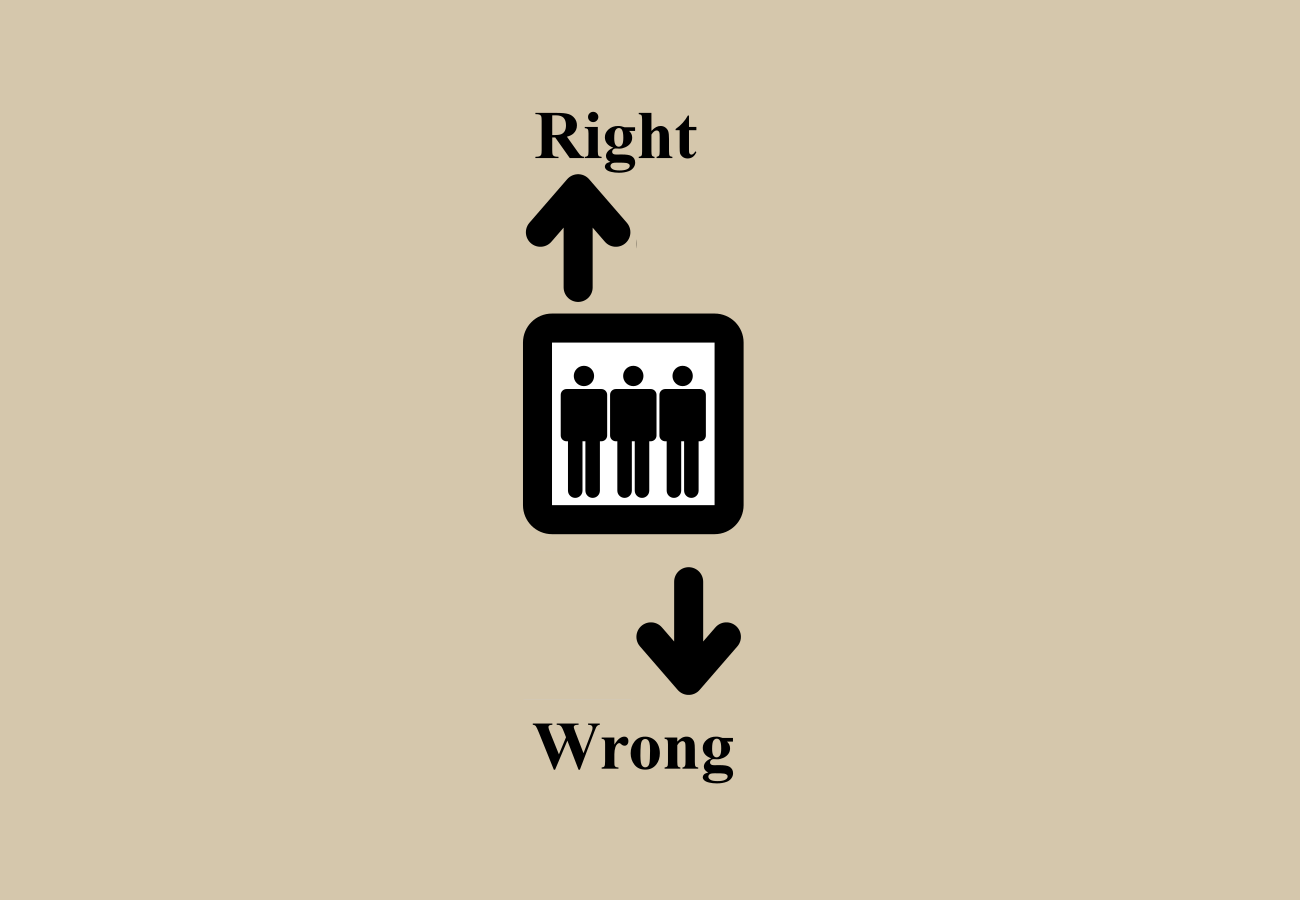
The perfect elevator
The following procedure is recommended
When completing tasks or dealing with people, replace
- the two extremes of right or wrong with the gradations
- very good, good, satisfactory, sufficient, inadequate and insufficient.
Replacing the two extremes of right and wrong with gradations helps to reduce inner tension
Example - Perfect worlds
If you think of perfection, there are only two possibilities: right or wrong. Gradations and shades of gray are not used.
Practical application
- Use gradations such as very good, good, satisfactory, sufficient, inadequate and insufficient.
The perfect elevator
Do you know an elevator that always takes you straight to the floor you want? That would be perfect! Or have you ever had to travel in the opposite direction? Could you live with it? If you always have to have everything perfect, you might think: Did the elevator have a defect? Wouldn’t it be better to take it out of service and use the stairs? Or is it not enough to reach the desired floor a few seconds later?
The perfect restaurant
Do you know a restaurant that serves either perfect or bad food? Sometimes it tastes good, sometimes very good. Maybe you are not satisfied sometimes. Would you then visit the restaurant again? Do you always expect to be served perfect food? When does a meal deserve an unsatisfactory rating? When the food is only slightly oversalted or only when the ingredients are spoiled?
The perfect disco
Do you know a disco where either only great songs or bad songs are played? Is the mix of songs usually not good to satisfactory, and on some days even sufficient? Is that why the disc jockey is bad? Should he be fired? Will you visit the discotheque again, even if you know that your favorite song might not be played? And if a birthday song is played, should the operator’s license be revoked or would the evening still be satisfactory for you?
The perfect relationship
Have you ever been in a relationship where the couple either always loves each other or always hates each other? Aren’t there days when you sometimes get on better and sometimes worse? Is that enough for a good relationship or is it not better to break up immediately after an argument? Is there a way for us to look perfect when we wake up in the morning? And if not, have we failed? Are a sleepy expression or unkempt hair inadequate to insufficient and a reason for breaking up?
The perfect dancer
Have you ever stepped on your dance partner’s foot? Have you failed as a dancer and should leave the dance floor? Should you give up dancing altogether? Are you always in the same form when dancing or do you sometimes do better and sometimes worse? Can watching others dance be enough? Does your personal dance style always have to look perfect? Can you still dance well with ski boots on your feet?
Perfect performance
Do you always have to perform perfectly and be fully focused? And if you are not well-rested, will you fail at work or fail with the task? Does it make sense to start a job even if you cannot guarantee that you will always perform perfectly? And if the boss likes your work or praises your reliability. Do you then go to the boss and ask for your resignation because he has only judged you to be reliable and not very reliable?
© 2025 PIRKA® Wolfgang Smidt. The content provided on this website is protected by copyright. Any use requires the prior written consent of the author. The information and advice provided has been compiled to the best of our knowledge and carefully checked. However, it is no substitute for expert psychological and medical advice in individual cases.
Give it a try!
PIRKA wishes you every success in implementing it.
Literature
Beck, T. & Freeman, A. (1993). Kognitive Therapie der Persönlichkeitsstörungen. Weinheim: Beltz.
De Jong-Meyer, R. (2000). Kognitive Verfahren nach Beck und Ellis. In Margraf, J. (Hrsg.), Lehrbuch der Verhaltenstherapie, Band 1. (S. 509-524). Berlin: Springer.
Fiedler, P. (2007). Persönlichkeitsstörungen. Weinheim: Beltz.
Hautzinger, M. (2011). Kognitives Neubenennen und Umstrukturieren. In Linden, M. & Hautzinger, M. (Hrsg.), Verhaltenstherapiemanual (S. 203-207). Berlin: Springer.
Mühlig, S. & Poldrack, A. (2011). Kognitive Therapieverfahren. In Wittchen, H.-U. & Hoyer, J. (Hrsg.), Klinische Psychologie & Psychotherapie. (S. 543-564). Heidelberg: Springer.
Ülsmann, D. & Ertle, A. (2017). Kognitive Umstrukturierung und Verhaltensexperimente. In Brakemeier, E.-L. & Jacobi, F. (Hrsg.), Verhaltenstherapie in der Praxis (S. 273-292). Weinheim: Beltz.
Shorten waking phases
The following procedure is recommended
- only go to bed when you feel tired,
- halve waking periods of more than 60 minutes during the night,
- stay up longer for the time gained and engage in a pleasant activity.
If the length of the waking phase does not decrease after 1 week, extend the procedure by a further week. You can find out how much sleep you personally need.
Important note
Sleep problems should not be the result of the consumption of nicotine, caffeine, alcohol, other psychoactive substances or organic sleep disorders.
Shortening longer periods of wakefulness during the night helps to adapt bedtime to your personal sleep needs.
Example 1 - Going to bed “on time” promotes waking phases
Sleep was very important to him and he wanted to plan enough time for his sleep. He therefore went to bed on time whenever possible. He based this on the word “on time” and not on whether he was already tired. Being tired means feeling sleep pressure, i.e. a clear tiredness. As a result, he regularly went to bed too early and woke up again and again.
Practical application
If he added up the time until he was finally able to fall asleep, he was sure to get 60 minutes. So he divided the 60 minutes by two and came up with 30 minutes, which he then stayed up longer the next day watching TV. When he still didn’t fall asleep any quicker after this week, he only went to bed the following week when he was clearly tired.
Example 2 - longer waking phases during the night
She woke up at least three times a night and then went through various problems in her mind. By looking at the alarm clock, she knew that she spent about 140 minutes a night desperately trying to get back to sleep.
Practical application
So she divided 140 by two and decided to go to bed 70 minutes later next time. She wanted to find out her natural need for sleep. Sometimes she read a book sitting next to her bed, other times she stayed longer with her friend. She would come up with something.
© 2025 PIRKA® Wolfgang Smidt. The content provided on this website is protected by copyright. Any use requires the prior written consent of the author. The information and advice provided has been compiled to the best of our knowledge and carefully checked. However, it is no substitute for expert psychological and medical advice in individual cases.
Give it a try!
PIRKA wishes you every success in implementing it.
Literature
Backhaus, J. & Riemann, D. (1999). Schlafstörungen. Fortschritte der Psychotherapie. Göttingen: Hogrefe.
Crönlein, T. (2013). Primäre Insomnie. Ein Gruppentherapieprogramm für den stationären Bereich. Göttingen: Hogrefe.
Gerrig, R.J., Dörfler, T. & Roos, J. (Hrsg.) (2018). Psychologie. München: Pearson.
Hertenstein, E., Nissen, C. & Riemann, D. (2017). Insomnie. In Brakemeier, E.-L. & Jacobi, F. (Hrsg.). Verhaltenstherapie in der Praxis. Weinheim: Beltz.
Riemann, D. (2004). Ratgeber Schlafstörungen. Göttingen: Hogrefe.
Riemann, D. (2011). Schlafstörungen. In Linden, M. & Hautzinger, M. (Hrsg.). Verhaltenstherapiemanual. Heidelberg: Springer.
Scharfenstein, A. & Basler, H. D. (2004). Schlafstörungen. Göttingen: Vandenhoeck & Ruprecht.