


relaxONnaming® the surroundings
The following procedure is recommended
- observe the surroundings,
- name the things, objects or people you see,
- only ever use one (!) word when naming,
- say the word silently in your mind,
- take a short break after each word,
- in which your gaze wanders calmly on and
- name another thing, object or person.
- Continue the exercise until the mind has calmed down.
It takes a little time for the thoughts you were previously preoccupied with to calm down.
Practicing twice a day for 2 minutes may be enough.
Important note
Observing and naming external circumstances is merely a spatial orientation exercise. However, if you start to feel uncomfortable, you can stop the exercise at any time by concentrating on another task or activity.
Advantages of relaxONnaming®
- relaxONnaming is easy to learn,
- the exercise can be carried out unnoticed by third parties,
- relaxONnaming can be used in different places and at any time.
Important note
Do not use relaxONnaming the surroundings when driving a vehicle or operating machinery, as it can cause you to fall asleep when you are already tired.
relaxONnaming – Observing and naming our surroundings can help us find mental peace.
Example 1 - Naming people / things / objects
He observed the people around him. It is important to find simple and general words that come to mind quickly. Just use: man and woman for different people, including people you know. He met his neighbor Mr. Lustig. He said the word “man” in his mind. Short break, during which the gaze continues to wander calmly. Then he saw Mrs. Fleißig, the owner of the small store. He said the word “woman” in his mind. Then his gaze wandered calmly to the street. In his mind he said the word: “Street”. Short break, during which the gaze continues to wander calmly. His gaze fell on a bucket. In his mind he said the word: “bucket”. His gaze wandered further and he saw a stone. In his mind he said the word: “stone”. Short break, during which the gaze continues to wander calmly. Then he saw a parked bus. In his mind he said the word: “bus”. Then his gaze fell on a manhole cover, a letterbox, a handkerchief, a window, a step, a paper cup …
Practical application
While observing, he named the people or objects and said the respective word in his mind: man … short break, during which the gaze continues to wander calmly … woman … short break, during which the gaze continues to wander calmly … bucket … short break … stone … short break … bus … short break … lid … short break … letterbox … short break … handkerchief … short break … window … short break … step … short break … cup …
Example 2 - At the workplace
She was at work. Time was pressing and in a few minutes there would be a conference at the other end of the building. She was still excited from the previous meeting. Her thoughts were revolving around the topics discussed. So she sought a little mental peace. On the way to the conference room, she began to name things that caught her eye. She let her gaze wander calmly down the long corridor.
Her eyes first fell on a colleague. She said the word “colleague” in her mind. Short break, during which the gaze continues to wander calmly. Then her gaze fell on the carpet. In her mind she said the word: “carpet”. Short break, during which the gaze continues to wander calmly. Then she looked at a glass table. In her mind she said the word: “table”. Short break, during which the gaze continues to wander calmly. Then she looked at a picture on the wall. In her mind she said the word: “picture”. Then her gaze fell on the long corridor. In her mind she said the word: “corridor”. Then she looked at a window. In her mind she said the word: “window”. Short break, during which the gaze continues to wander calmly to the ceiling lamp: “lamp”, the colleague, the fire extinguisher, the railing …
Practical application
While observing, she named the people or objects and said the respective word silently to herself: colleague … short break, during which the gaze continues to wander calmly … carpet … short break, during which the gaze continues to wander calmly … table … short break, during which the gaze continues to wander calmly … picture … short break … corridor … short break … window … short break, during which the gaze continues to wander calmly … lamp … short break … colleague … short break … fire extinguisher … short break … railing … short break …
© 2025 PIRKA® Wolfgang Smidt. The content provided on this website is protected by copyright. Any use requires the prior written consent of the author. The information and advice provided has been compiled to the best of our knowledge and carefully checked. However, it is no substitute for expert psychological and medical advice in individual cases.
Give it a try!
PIRKA wishes you every success in implementing it.
Literatur articles
Baltissen, R. & Sartory, G. (1998). Orientierungs-, Defensiv- und Schreckreaktionen: Grundlagenforschung und Anwendung. In Rösler, F. (Hrsg.). Ergebnisse und Anwendungen der Psychophysiologie. Enzyklopädie der Psychologie. Biologische Psychologie. (S. 1-35)
Bateson, G. (1981). Ökologie des Geistes. Frankfurt. Suhrkamp.
Bösel, R. (2009). Neuropsychologie. In Brandstätter, V. & Otto, J. H. (Hrsg.). Handbuch der Allgemeinen Psychologie. Motivation und Emotion. Göttingen: Hogrefe.
Dörner, D. (1998). Emotionen, kognitive Prozesse und der Gebrauch von Wissen. In Klix, F. & Spada, H. (Hrsg.), Enzyklopädie der Psychologie. Wissen. Kognition. (S. 301-330). Göttingen: Hogrefe.
Eimer, M., Nattkemper, D., Schröger, E & Prinz, W. (1996). Unwillkürliche Aufmerksamkeit. In O. Neumann & A. F. Sanders (Hrsg.), Enzyklopädie der Psychologie. Aufmerksamkeit. Kognition 2 (S. 219-258). Göttingen: Hogrefe.
Gamer, M. (2019). Aufmerksamkeit. In Pinel, J. P. J., Barnes, S. J. & Pauli, P. (Hrsg.). Biopsychologie. München: Pearson.
Grawe, K. (2004). Neuropsychotherapie. Göttingen: Hogrefe.
Haynes, J.-D. (2013). Bewusstsein und Aufmerksamkeit. In Schröger, E. & Koelsch, S. (Hrsg.). Affektive und Kognitive Neurowissenschaft. Enzyklopädie der Psychologie. Kognition 5 (S. 47-78). Göttingen: Hogrefe.
Herrmann, T. (2003). Planung und Regulation der Sprachproduktion. In Herrmann T. & Grabowski, J. (Hrsg.), Enzyklopädie der Psychologie. Sprachproduktion. Sprache 1 (S. 309-327). Göttingen: Hogrefe.
Hoffmann, J. (1994). Die visuelle Identifikation von Objekten. In Prinz, W. & Bridgeman, B. (Hrsg.), Enzyklopädie der Psychologie. Wahrnehmung. (S. 391-444). Göttingen: Hogrefe.
Kintsch, W. (1982). Gedächtnis und Kognition. Heidelberg: Springer.
Klix, F. (1976). Information und Verhalten. Kybernetische Aspekte der organismischen Informationsverarbeitung. Bern: Huber.
Klix, F. (1976). Über Grundstrukturen und Funktionsprinzipien kognitiver Prozesse. In F. Klix (Hrsg.). Psychologische Beiträge zur Analyse kognitiver Prozesse. Kindler: München.
Klix, F. (1998). Begriffliches Wissen – episodisches Wissen. In Klix, F. & Spada, H. (Hrsg.), Enzyklopädie der Psychologie. Wissen. Kognition 6 (S. 167-205). Göttingen: Hogrefe.
Koelega, H.S. (1996). Vigilanz. In O. Neumann & A. F. Sanders (Hrsg.), Enzyklopädie der Psychologie. Aufmerksamkeit. Kognition 2 (S. 403-467). Göttingen: Hogrefe.
Lau, F. (2012). Die Form der Paradoxie. Eine Einführung in die Mathematik und Philosophie der Laws of Form von George Spencer Brown. Heidelberg: Carl-Auer.
Luhmann, N. (1998). Die Wissenschaft der Gesellschaft. Frankfurt: Suhrkamp.
Luhmann, N. (2004). Einführung in die Systemtheorie. Heidelberg: Carl Auer.
Manzey, D. (1998). Psychophysiologie mentaler Beanspruchung. In F. Rösler (Hrsg.), Enzyklopädie der Psychologie. Ergebnisse und Anwendungen der Psychophysiologie. Biologische Psychologie. (S. 799-850). Göttingen: Hogrefe.
Mecklinger, A. (2013). Neurokognition des Erinnerns. In Schröger, E. & Koelsch, S. (Hrsg.). Affektive und Kognitive Neurowissenschaft. Enzyklopädie der Psychologie. Kognition 5 (S. 155-180). Göttingen: Hogrefe.
Moosbrugger, H. & Oehlschlägel, J. (2019). FAIR-2. Frankfurter Aufmerksamkeits-Inventar 2. (2., überarb. u. erg. Auflage des FAIR 1996). Göttingen: Hogrefe.
Müller, H. & Krummenacher, J. (2012). Funktionen und Modelle der selektiven Aufmerksamkeit. In Karnath, H-O. & Thier, P. (Hrsg.). Kognitive Neurowissenschaften. Berlin: Springer.
Norman, D. & Bobrow, G. (1975). On Data-limited and Ressource-limited Processes. Cognitive Psychology, 7, 44-64
Olst, E. H. ((1971). The Orienting Reflex. Mouton. De Gruyter.
Pechmann, T. (2003). Experimentelle Methoden. In Herrmann T. & Grabowski, J. (Hrsg.), Enzyklopädie der Psychologie. Sprachproduktion. Sprache 1 (S. 27-45). Göttingen: Hogrefe.
Schönwälder, T., Wille, K. & Hölscher, T. (2004). George Spencer-Brown. Eine Einführung in die „Laws of Form“. Wiesbaden: VS Verlag.
Schröger, E. & Koelsch, S. (2013). Bemerkungen zu einer Affektiven und Kognitiven Neurowissenschaft. In Schröger, E. & Koelsch, S. (Hrsg.). Affektive und Kognitive Neurowissenschaft. Enzyklopädie der Psychologie. Kognition 5 (S. 1-9). Göttingen: Hogrefe.
Schweizer, K. (2003). Das sprachliche Lokalisieren. In Herrmann T. & Grabowski, J. (Hrsg.), Enzyklopädie der Psychologie. Sprachproduktion. Sprache 1 (S. 623-652). Göttingen: Hogrefe.
Semmer, N. K., Grebner, S. & Elfering, A. (2010). Psychische Kosten von Arbeit: Beanspruchung und Erholung, Leistung und Gesundheit. In U. Kleinbeck & K. H. Schmidt (Hrsg.), Enzyklopädie der Psychologie. Arbeitspsychologie. (S. 325-358). Göttingen: Hogrefe.
Sokolov, E. N. (1963). Perception and the Conditioned Reflex. Oxford: Pergamon Press.
Sokolov, E. N., Spinks, J. A., Näätänen, R. & Lyytinen, H. (2002). The Orienting Response in Information Processing. London: Lawrence Erlbaum Associates.
Sokolov, E. N. (2013). The Psychophysiology of Conciousness. New York: Oxford University Press.
Spencer-Brown, G. (1979). Laws of Form. New York: Dutton.
Sturm, W. (2008). Aufmerksamkeitsstörungen. In Gauggel, S. & Herrmann, M. (Hrsg.). Handbuch der Neuro- und Biopsychologie. Göttingen: Hogrefe.
van der Heijden, H. C. (1996). Visuelle Aufmerksamkeit. In. Neumann, O. & Sanders, A. F. (Hrsg.). Aufmerksamkeit. Enzyklopädie der Psychologie. Aufmerksamkeit. Kognition 2. (S. 7-50). Göttingen: Hogrefe.
van der Meer, E. & Klix, F. (2003). Die begriffliche Basis der Sprachproduktion. In Herrmann T. & Grabowski, J. (Hrsg.), Enzyklopädie der Psychologie. Sprachproduktion. Sprache 1 (S. 333-355). Göttingen: Hogrefe.
van der Molen, M.W. (1996). Energetik und der Reaktionsprozess. Zwei Leitlinien der Experimentalpsychologie. In O. Neumann & A. F. Sanders (Hrsg.), Enzyklopädie der Psychologie. Aufmerksamkeit. Kognition 2 (S. 333-395). Göttingen: Hogrefe.
von Weizsäcker, E. U. (1986). Erstmaligkeit und Bestätigung als Komponenten der pragmatischen Information. In von Weizsäcker, E. U. (Hrsg.). Offene Systeme I. Beiträge zur Zeitstruktur von Information, Entropie und Evolution. Stuttgart: Klett-Cotta.
Weiß, P. & Barattelli, S. (2003). Das Benennen von Objekten. In Herrmann T. & Grabowski, J. (Hrsg.), Enzyklopädie der Psychologie. Sprachproduktion. Sprache 1 (S. 587-615). Göttingen: Hogrefe.

talk2b® - beyond judgment
The following approach is recommended
- Pay attention to behaviors or events that are observable and nameable,
- pay attention to their consequences and effects, which are observable and nameable,
- pay attention to your own feelings that are observable and nameable due to behavior or events,
afterwards
- Starting sentences with “I” or “me” protects us from accusatory and reproachful-sounding “you” sentences,
- Addressing our own feelings makes our situation understandable to others,
- Naming behavior and events,
- name their consequences and effects,
- making a request brings us closer to our goals.
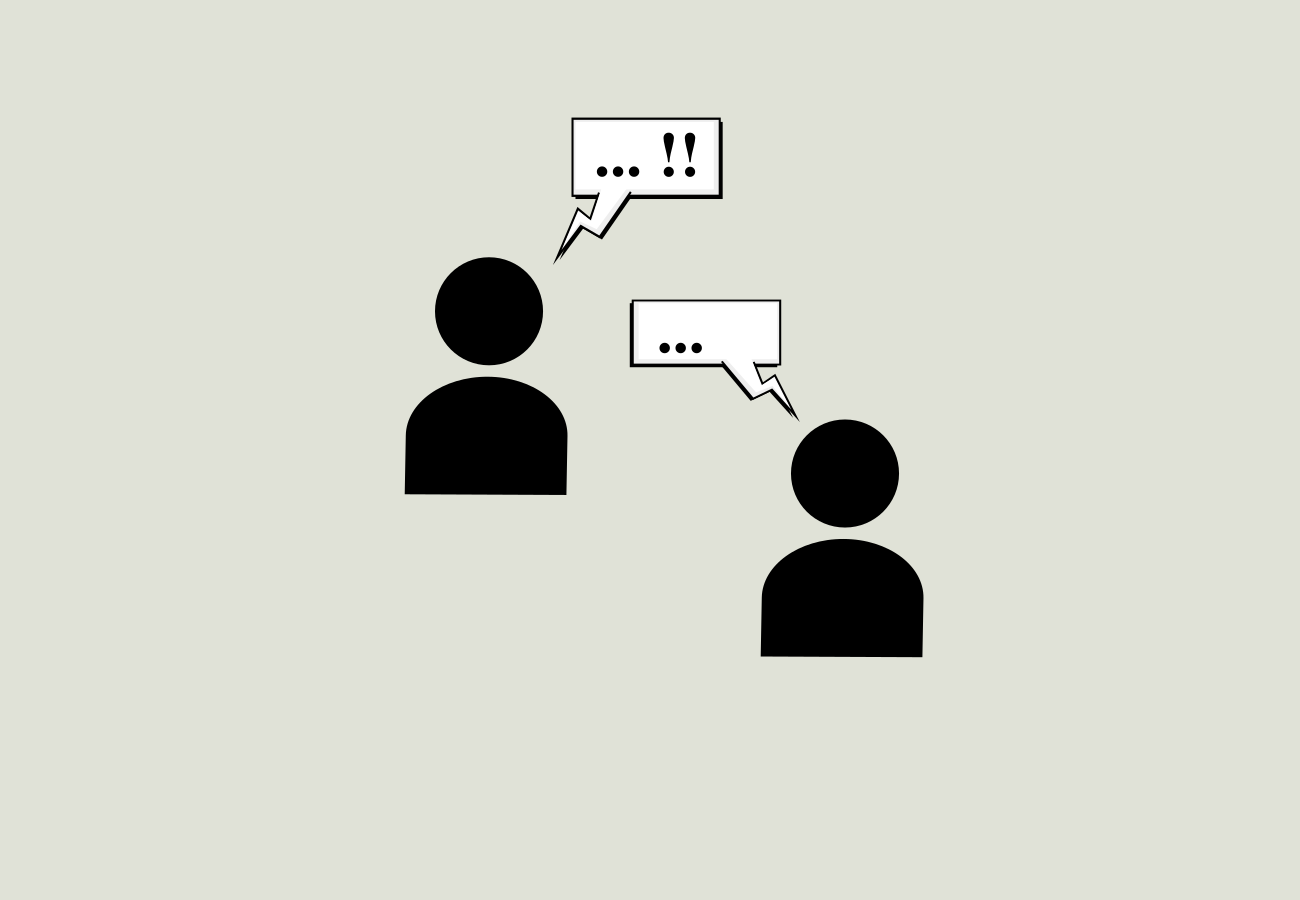
Using talk2b in conversations means going beyond judgment and addressing only observable and nameable facts and their consequences.
Example 1 - fresh air in the office
Your colleague loved fresh air. Whether it was summer or winter, the window in the office always had to be open. She then sat in a draught, which annoyed her. She was also afraid of catching a cold. But every time she closed the window, her colleague opened it again. Should she say something? She decided to use talk2b and confront her colleague about his behavior and the consequences.
Practical application
- Pay attention to behaviors or events that are observable and nameable.
“Every time she closes the window, her colleague opens it again.”
- Pay attention to their consequences and effects, which are observable and nameable.
“She sits in a draught.”
- Pay attention to your own feelings that are observable and nameable due to behavior or events.
“Anger about sitting in a draught. Fear of catching a cold.”
afterwards
- Starting sentences with “I” or “me” protects us from accusatory and reproachful-sounding “you” sentences,
- Addressing our own feelings makes our situation understandable to others.
“It annoys me that … it bothers me that … I’m afraid that …”
- Name behavior and events.
“It annoys me that you keep opening the window when I close it.”
- Name its consequences and outcomes.
“I am afraid of catching a cold.”
- Making a request brings us closer to our goals.
“Let’s agree to open the window during the breaks.”
It annoys me that you keep opening the window when I close it. I’m afraid I’ll catch a cold. Let’s agree to open the window during breaks.
She noticed that using talk2b also led to positive experiences with her husband, children and friends. By only ever addressing events and behaviors, no one had to feel attacked and judged as a person.
Example 2 - the stranger on the bus
He was waiting for the bus after work. Earlier in the morning, he had been carrying a heavy bag while shopping. His back had been hurting all day. So he adopted a relaxed posture and stood at an angle. I wonder what people thought? The bus arrived. It took him what felt like an eternity to get on the bus. A stranger made a seat available and gave him a friendly nod. He wanted to say thank you and thought about using talk2b.
Practical application
- Pay attention to behaviors or events that can be observed and named.
The stranger offers him his seat.
- Pay attention to their consequences and effects, which are observable and nameable.
The back pain is more bearable when sitting.
- Pay attention to your own feelings that are observable and nameable due to behavior or events.
Be happy that there are attentive fellow human beings.
afterwards
- Starting sentences with “I” or “me” protects us from accusatory and reproachful-sounding “you” sentences.
- Addressing our own feelings makes our situation understandable to others.
“I am pleased that … I am grateful that …”
- Name behavior and events.
“I am grateful to you for allowing me to sit.”
- Name its consequences and effects.
“My back pain is now more bearable.”
I am grateful to you for allowing me to sit. It makes my back pain more bearable.
He noted that using talk2b helped the man understand how much he had helped him.
Example 3 - communicating as a partner
He knew that in relationships, whether new or long-standing, you have to work on yourself. He had read in one of the many books that the quality of a relationship depends crucially on how people talk to each other. What should he do? He wished his wife would give him a hug more often, because it calmed him down after a stressful day at work. But she rarely did, which made him more and more sad. He wanted to tell her. But he didn’t want it to come across as an attack or a reproach. He decided to give talk2b a try.
Practical application
- Pay attention to behaviors or events that can be observed and named.
His wife rarely gives him a hug.
- Pay attention to their consequences and effects, that can be observed and named.
Calming down after a stressful day at work.
- Pay attention to your own feelings that are observable and nameable due to behavior or events.
Sadness that hugging does not happen as often.
afterwards
- Starting sentences with “I” or “me” protects us from accusatory and reproachful-sounding “you” sentences.
- Addressing our own feelings makes our situation understandable to others.
“I am a little sad that …”
- Name behavior and events.
“… you don’t hug me more often.”
- Name its consequences and outcomes.
“Being hugged brings me a pleasant sense of calm.”
- Making a request brings us closer to our goals.
“Please give me a warm welcome in your arms when I get home from work.”
I’m a little sad that you don’t hug me more often. Being held in your arms brings me a pleasant calm. Please give me a warm welcome hug when I come home from work.
talk2b helps other people to understand you better and not to feel attacked.
© 2025 PIRKA® Wolfgang Smidt. The content provided on this website is protected by copyright. Any use requires the prior written consent of the author. The information and advice provided has been compiled to the best of our knowledge and carefully checked. However, it is no substitute for expert psychological and medical advice in individual cases.
Give it a try!
PIRKA wishes you every success in implementing it.
Literatur articles
Altmann, T. (2020). Gewaltfreie Kommunikation. In Wirtz, M. A. (Hrsg.). Dorsch. Lexikon der Psychologie (S. 961). Bern: Hogrefe
Grawe, K., Donati, R. & Bernauer, F. (2001). Psychotherapie im Wandel. Von der Konfession zur Profession. Göttingen: Hogrefe
Hahlweg, K., Schröder, B. & Weusthoff, S. (2011). Kommunikationstraining. In Linden, M. & Hautzinger, M. (Hrsg.). Verhaltenstherapiemanual (S. 403-408). Berlin: Springer
Helbig-Lang, S., Klose, M. & Berking, M. (2020). Trainings emotionaler, sozialer und kommunikativer Fertigkeiten. In Hoyer, J. & Knappe, S. (Hrsg.). Klinische Psychologie und Psychotherapie (S. 695-708). Berlin: Springer
Helbig-Lang, S. & Klose, M. (2011). Trainings der Selbstsicherheit, sozialer Fertigkeiten und der Kommunikation. In Wittchen, H. U. & Hoyer, J. (Hrsg.). Klinische Psychologie und Psychotherapie (S. 565-585). Berlin: Springer